Delhi’s LG Anil Baijal on 16th of May, 2017 (Friday) approved Land Pooling villages to be declared as developed areas. This will give a big push to Delhi’s planned development and affordable housing under DDA’s ambitious Land Pooling Policy (LPP).
The villages under Delhi’s Land Pooling policy are spread over nearly 77,000 acres, of which around 50 percent land will be made available to developer entities for real estate. The development of these 95 villages will result in over 25 lakh houses in the planned areas of the city. DDA will also be responsible for sewerage, water supply, electricity supply, bus terminals etc, and also return a portion of the plot to farmers.
To many, the news came through LG’s tweet, “Approved notification of 95 villages as development areas of DDA. Push for affordable housing, social and physical infrastructure needs of Delhi (sic).”
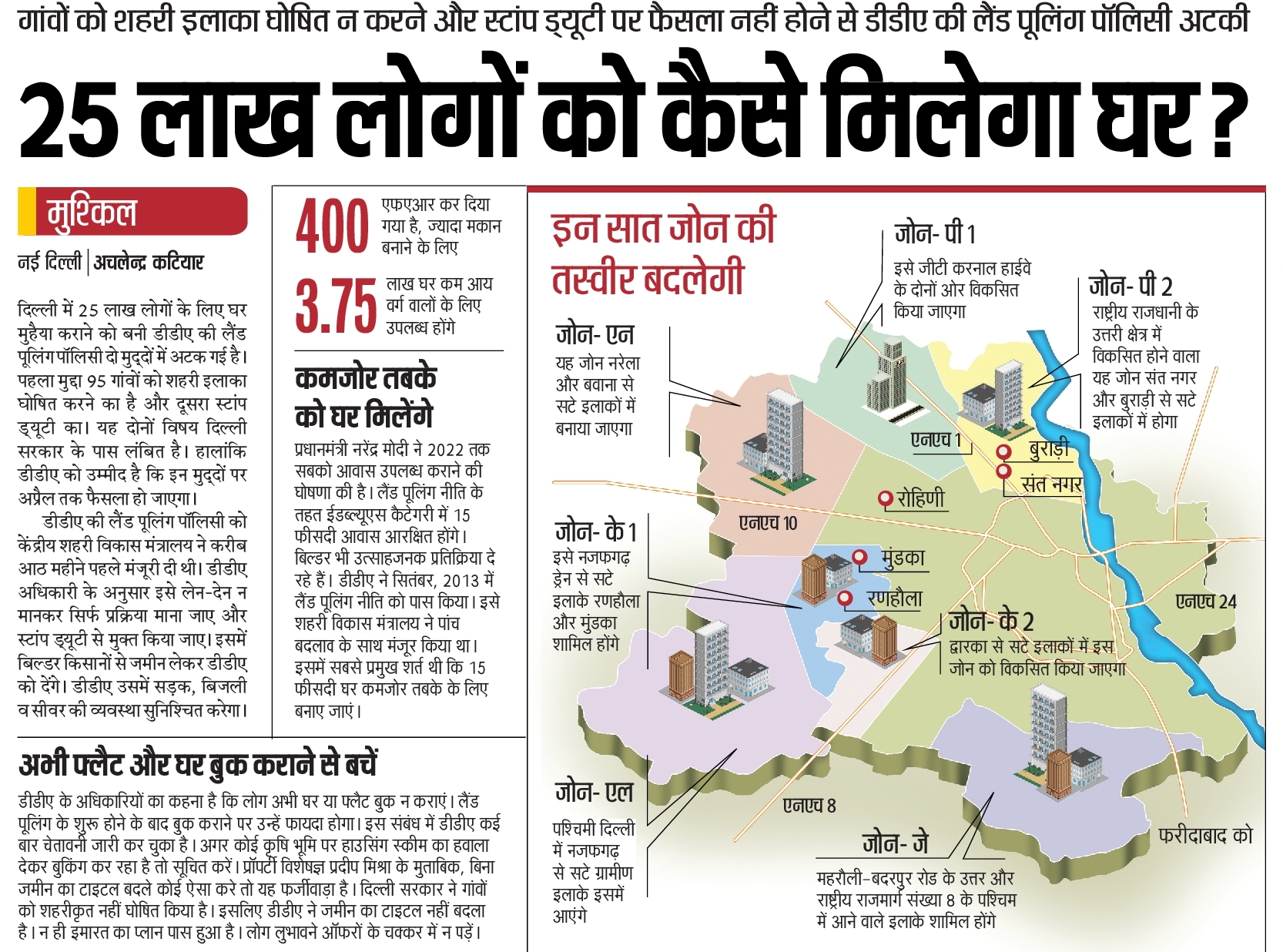
The villages to be developed under land pooling are from Delhi’s five zones, namely, Zone K1, L, N, P-II, and J.
Per DDA’s Land Pooling policy, individuals or a group of land owners owning land in villages in above mentioned five zones, marked for land pooling, can pool their land and hand it over to the Delhi Development Authority (DDA), which will develop basic public infrastructure like roads, before returning a substantial portion back to the owner.
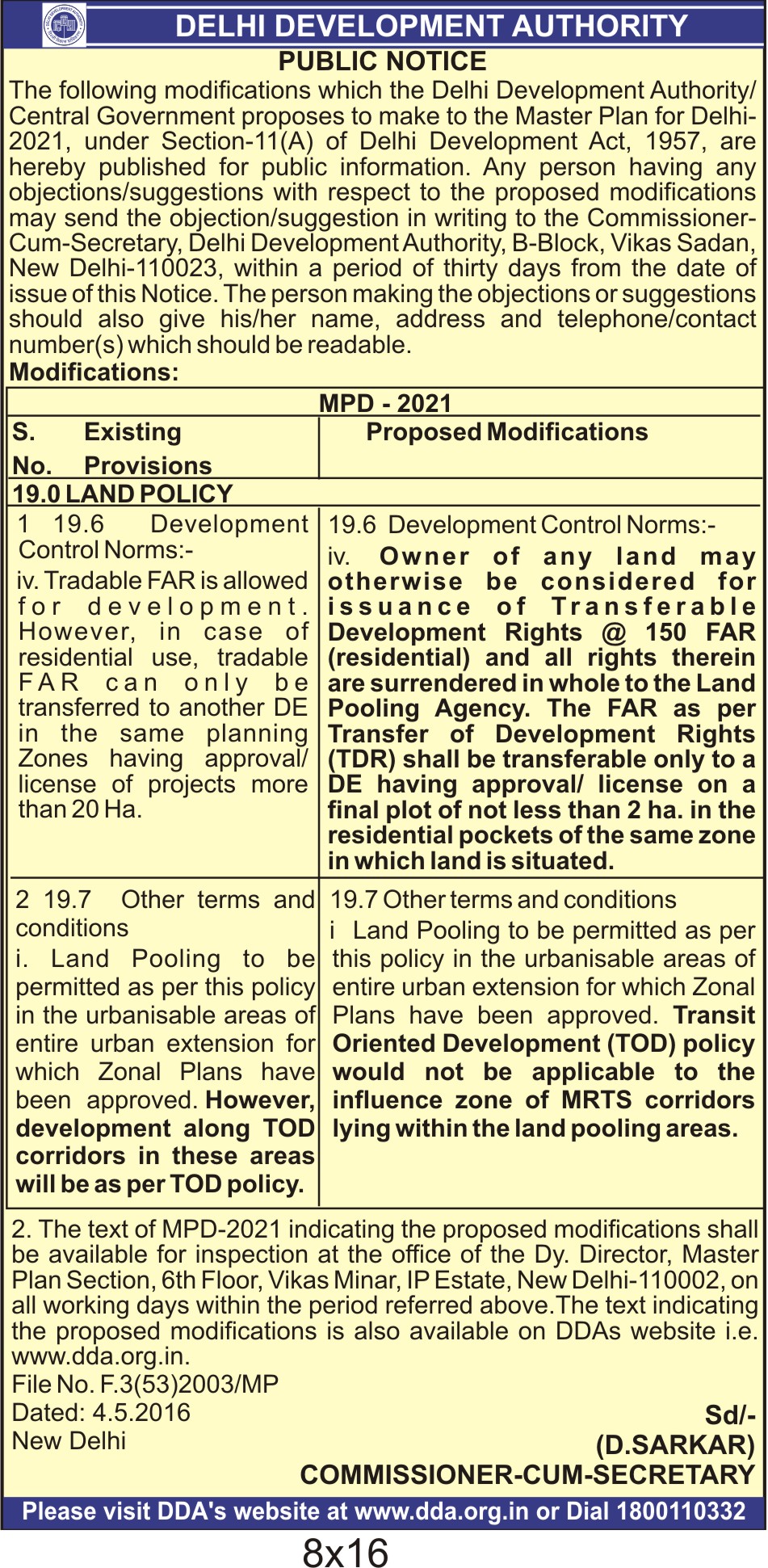
The land owners offering between 5 to 50 acres of land for development will receive 48% (43%+3%+2%) of their land back, and those who would be pooling 50 acres or more of their land would get 60% (52%+5%+3%) of their pooled land back once the development is completed.
The leftover land will be used by DDA for purposes such as infrastructure development.
After initial setbacks/hurdles, the land pooling policy is set to change the character of the rural part of Delhi.
In a major development, LG has declared 89 villages in Delhi, marked for Land Pooling, as urban areas. The Urban Development Department of the Delhi government issued a notification in this regard in May, 2017, after Lt Governor Anil Baijal approved the Delhi Development Authority’s Land-Pooling Policy (LPP).
The policy was stuck for quite some time, leading to the mushrooming of unauthorized colonies in these rural areas. The proposal to allow land pooling is almost a decade old. Delhi Development Authority had notified the policy in June 2015. But it could not be implemented as the state government refused to address the file related to change of the land use of the village’s agricultural land.
The land use of the said agricultural land, falling under the scope of Delhi’s land pooling policy, was to be changed in two steps. On 16th May, 2017 (Tuesday), notification was done to change the character of the villages under land pooling policy from rural to urban areas. In the second step, this land will be declared as ‘development area’. After that, the land use will automatically become non-agriculture. Then, farmers will be asked to pool in their land under DDA’s policy by submitting the land documents, for land pooling to take place.
The LPP is aimed at getting individuals or a group of land-owners – living in urban villages on Delhi’s periphery – to pool their land and hand it over to the DDA. Delhi government will get land from DDA for developing facilities such as electrical sub-stations, schools etc.
The DDA will develop public infrastructure, such as, roads, on part of the pooled land and return a portion of the plot to the owner. The owners with upto 50 acres of land will get around 48% of their land share back and the ones with more than 50 acres will get around 60% of their pooled land back from the DDA. The returned portion of the land will have its value increased due to the development of infrastructure nearby.
The policy’s implementation is significant as this will pave way for the development of 25 lakh housing units and around 5 lakh EWS (Economically Weaker Sections) units. Providing relief to small farmers, self-penalty on DDA for delays, and flexibility to farmers to trade their land or tie up with developers for land-pooling are some of the important features of the policy.
A high level meeting, chaired by Rajiv Gauba (Secretary, Ministry of Urban Development) and attended by senior officials of all the departments (Ministry of UD, Govt of NCT of Delhi, DDA and North and South Muncipal Authorities), was held on Tuesday (November 1, 2016) to sort out issues and enable Notification of Land Pooling Policy regulations.
Gram sabha land was identified and marked to be kept separate from Land Pooling, as was asked by Delhi Govt.
North and South Muncipal bodies have passed resolutions for notifying 89 villages as urban areas.
Delhi Govt gave a in-principal nod to the Land Pooling Policy. Chief Minister, Mr Arvind Kejriwal, openly lauded the policy.
Issue: Delhi Govt has sought some clarifications regarding provision of civic amenities in the developed areas.
Solution: Both the MCDs (North and South) have been asked by the Ministry to expedite their reply to the Delhi Govt.
Issue: Delhi Govt had asked for 10% of developed land for infrastructure development.
Solution: DDA in the meeting stated that transfer of developed land would be provided to the Delhi government on need basis as is being done now in accordance with the Master Plan of Delhi.
Also, the Delhi government was requested to consider the issue of waiver of stamp duty on transfer of developed land to Developer Entity (DE).
With this, Delhi Govt. was requested to expedite notification of the villages as urban areas and development areas. To this, Delhi government assured that local revenue officials would at the earliest verify the ‘Sajra’ maps of these villages falling under land pooling ambit.
There are a number of options in the market for homebuyers interested in DDA’s Land Pooling Policy. This comprises of both Societies and builders. Also, there is no clarity on the legality of their existence and if they could sell the units before the commencement of anything concrete on the ground. So if one still feels keen in looking into the available options, we would like to offer a check list for the prospective buyers.
A number of like-minded individuals come together and decides to take a route leading them towards a common interest. With time more people would join the bandwagon ensuring the sustainability of the idea. As far as we understand, societies have always worked on a similar principal. DDA’s Land Pooling Policy is one such lucrative concept which has lured people from public / private companies alike into forming such housing /welfare societies to take advantage of the policy. DDA too has abstained from taking a clear stand on the legitimacy of such societies.
One must take into account certain precautions before investing into any proposed society/builder project in any of the zones under LPP.
Registration and Mutation of Land:
First comes the NOC after which comes registration of the land. It is then followed by mutation which could also be considered the most important step towards the procurement. One must ensure that the society holds the required papers for the land they claim to be theirs.
Do a background check:
Not all societies would be formed by genuine beings. Try not to get swept away with the market sentiment and do a thorough check for the authenticity of the managing committee.
Societies are supposed to work on a no-profit no-loss basis and no commercial activity should be carried out by them. They are supposed to get their accounts audited after the end of every financial year. Better level of communication is expected since most of the times they get formed with the participation of known ones.
Centre, State Tussle on LPP has become the reason for holding up of Delhi’s humongous potential of creating affordable homes. Group of experts tries to dissect the issue between State and Centre Government to get to the root cause and a probable solution to the stand-off.
DDA officials, after considering the Delhi govt’s demand, have found it infeasible to be met. This comes out as another setback to Delhi’s Land Pooling Policy. The AAP govt had asked DDA for 12-15% of the pooled land to it for free for development projects.
Central government has agreed to give land at Re 1 per annum to the state government. Also, the transfer of gram sabha land has already been approved. Stating the same, DDA has said that the government’s demand for share in the total pooled land is not valid.
With this DDA has urged the AAP govt to expedite the implementation of land-pooling which has been stuck for quite some time now. The policy was notified in year 2013 and the operational guidelines were issued in year 2015. Since then the policy has been stuck for clearance from Delhi Govt.
The policy is considered to be important for providing housing to all. City’s ever growing housing demand and absence of any such planned approach to it had been responsible for mushrooming of such large scale unauthorized clusters.
It will be a big game changer once the Land pooling is approved by the Delhi Government and is implemented by DDA. Though, it’s easier said than done. Even after the villages are declared as development area by the Delhi govt, DDA might need more time to start the pooling process.
Delhi’s L-Zone is located in South-West Delhi and is strategically positioned between Dwarka and Gurgaon. It is the most popular zone among property buyers of all the zones in Land Pooling Policy; and is expected to give an impetus to the slow and stagnant real estate market of the national capital.
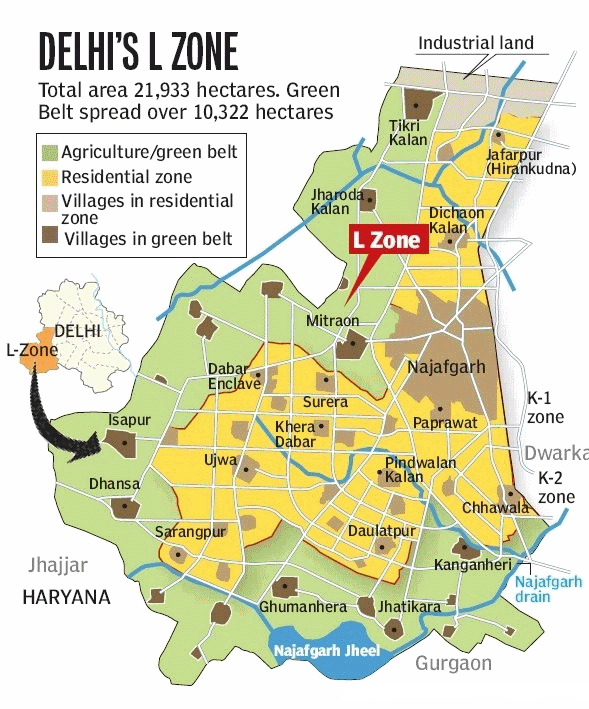
Zone L is the most popular zone among property buyers, housing societies and real estate developers. It has the highest land bank among all the zones in the MPD-2021. Many reputed builders of Delhi-NCR have not just stepped in but have already launched their new residential projects in L-Zone. L-Zone for being so strategically placed, is supposed to provide excellent returns on your investments. The property prices are way too low here as of now as compared to the adjacent already developed areas. But the land/property price in this zone is rising with each passing month.
L Zone, among all the zones, is probably the best in terms of location and connectivity.
L-Zone is close to IGI Airport. It is strategically located between Dwarka and Gurgaon; is close to Dwarka Sector 21 Metro Station and Dwarka expressway. The zone is in close proximity to New 18 Hole Golf Course, which is under construction and upcoming new diplomatic area. 80 M wide UER-II will connect L-zone with Airport, Dwarka and South-Delhi.
A substantial development of Residential, Commercial, Public and Semi-public segment will happen through public – private partnership. This is largest of all the zones to be a part of Delhi’s Land Pooling Policy. Hence it is expected to supply the largest share of property in the capital.
It is surrounded by NH-10/Rohtak Road and Railway Line on its North side; the NCT of Delhi’s boundary on its southern and western sides; and it is just a few kms away South Delhi and West Delhi.
Finally, after a very long silence, there has been a word from Delhi Govt on the Land Pooling policy. Delhi govt agrees to clear land-pooling policy. The AAP govt has demanded a share from the pooled land amounting to 12-15% of DDA’s share for carrying out development projects.
Per earlier news from govt officials /spokesperson(s), state govt was reviewing the policy at their end and they took considerable time before making an official statement.
Delhi govt has at times mentioned about difficulty in getting land from DDA for development work for which they are supposed to pay the authority. Per officials, govt would need land for building schools, stadiums, electrical sub-stations etc in the newly planned sub-cities.
Now the ball has rolled back to DDA’s court and they may respond to it after reviewing the Delhi govt’s demand.
Even with this, there are still some outstanding issues, such as, govt has yet to waive of stamp duty on to and fro transfer of land parcels to DDA.