


After approving the land pooling policy in September, last year, DDA is set to launch an online portal for operationalisation and implementation of the policy on 5th of Feb.
Also, a nodal officer has been appointed by DDA for it to coordinate with all service providing agencies, such as, DJB, PWD delhi, Transco etc.
Per officials, ‘integrated sector-based planning approach’ will be followed. A sector of 250 to 300 hectares of land will be eligible to be developed. A minimum of 70% contiguous land within a sector will need to be assembled to participate.
Keeping in line with the goal of ‘ease of doing business’, a single-window system is being created. This will be done to help with the implementation of the policy in DDA. All processes of receiving applications, verifications, grant of approvals and licences, etc., will be completed in a time-bound manner.
A two-stage grievance redressal mechanism has been set within DDA for transparent and people-friendly operationalization and implementation of the policy.
Under the policy, the FAR has been reduced to 200 as opposed to initially proposed FAR of 400.
Officials had maintained that reduction in FAR was done keeping in mind the availability of resources and services required for the development of a particular piece of land. The urban body will act as a “facilitator and planner” under the policy. The transfer of land to the DDA, which was proposed earlier, is no longer required.
DDA Vice-Chairman Tarun Kapoor had told The Hindu earlier this month, “The online portal for the land pooling policy is almost ready and trial runs are on currently.”
Also, DDA has initiated formation of an expert panel. Per reports, the panel formation should have completed by now. It will be comprised of town planners, planning and engineering experts etc. This panel will be responsible for drafting a detailed road-map for the policy. Firstly, zonal plans will be created which will be marked with details on land ear-marked for residential development, community halls, park, and parking and on sewerage and water pipe connectivity. The policy will then be carried forward per these details.
Courtesy: Navbharat Times, The Hindu, and other news sources.
In a major development, LG has declared 89 villages in Delhi, marked for Land Pooling, as urban areas. The Urban Development Department of the Delhi government issued a notification in this regard in May, 2017, after Lt Governor Anil Baijal approved the Delhi Development Authority’s Land-Pooling Policy (LPP).
The policy was stuck for quite some time, leading to the mushrooming of unauthorized colonies in these rural areas. The proposal to allow land pooling is almost a decade old. Delhi Development Authority had notified the policy in June 2015. But it could not be implemented as the state government refused to address the file related to change of the land use of the village’s agricultural land.
The land use of the said agricultural land, falling under the scope of Delhi’s land pooling policy, was to be changed in two steps. On 16th May, 2017 (Tuesday), notification was done to change the character of the villages under land pooling policy from rural to urban areas. In the second step, this land will be declared as ‘development area’. After that, the land use will automatically become non-agriculture. Then, farmers will be asked to pool in their land under DDA’s policy by submitting the land documents, for land pooling to take place.
The LPP is aimed at getting individuals or a group of land-owners – living in urban villages on Delhi’s periphery – to pool their land and hand it over to the DDA. Delhi government will get land from DDA for developing facilities such as electrical sub-stations, schools etc.
The DDA will develop public infrastructure, such as, roads, on part of the pooled land and return a portion of the plot to the owner. The owners with upto 50 acres of land will get around 48% of their land share back and the ones with more than 50 acres will get around 60% of their pooled land back from the DDA. The returned portion of the land will have its value increased due to the development of infrastructure nearby.
The policy’s implementation is significant as this will pave way for the development of 25 lakh housing units and around 5 lakh EWS (Economically Weaker Sections) units. Providing relief to small farmers, self-penalty on DDA for delays, and flexibility to farmers to trade their land or tie up with developers for land-pooling are some of the important features of the policy.
In a meeting held by the Federation of housing societies and developers and Delhi Dehat Kisan Morcha with Delhi CM, Sh Arvind Kejriwal, on the issues regarding implementation of the Land Pooling Policy, the latter has assured that the Delhi Govt will clear the file regarding Land Pooling by May 7.
The file was stuck with the Delhi Govt since a long time now. The latest bone of contention between the center and the State government was about transfer of 10 percent of pooled land to the Delhi govt for development purposes.
Chief Minister, Sh Kejriwal, was informed about the hassles being faced by farmers because of the delay in the declaration of 89 villages as urban villages and 95 as development areas and how it was proving responsible in halting the growth in the development of the Capital.
A lot many societies, builders and individual buyers have already invested huge sums in the zones marked for development under Land Pooling Policy. Per some inputs, over 30,000 crores have already been invested in purchasing land and all that investment has been stuck because of the tug of war between Center and State governments.
The policy was notified by the Congress government on 5th of Sep, 2013 and the operationalization of the draft regulations for the same was approved on 26th of May, 2015 with five amendments. Besides, concerned units of MCD have already passed resolutions and have sent their consents to the concerned department of Delhi Government for further approvals.
The assurance from the CM has once again raised the hopes of common man who had been eagerly waiting for the last hurdles in the implementation of the policy to resolve. This would pave way for large scale development of affordable housing on the lines of Dwarka and Rohini, within the City.
Refer below link for updates in Hindi on the same.
http://epaper.bhaskar.com/detail/874123/4431510265/cph/map/tabs-1/04-04-2017/194/1/image/
In this section, we will drill deeper into the concept to understand what must be the core Infrastructure to build up a Smart city.
Frost & Sullivan have identified eight key aspects that define a Smart City:
smart governance, smart energy, smart building, smart mobility, smart infrastructure, smart technology, smart healthcare and smart citizen
We have leveraged out of it while coming up with our own list.
Good governance:
This cannot be a one-time process. First and foremost there is a need to identify metrics to define it. Suggestions need to be sought from residents and experts alike. Consolidated list, then, should be filtered out to weed out parameters which could not be measured. Whole process should be put online for everyone’s review and then the process set must be evaluated for the actions taken. This could be used as a model to make new learnings and improvise the existing system in an incremental fashion.
Education:
We are not talking about just pre-schools, schools, colleges, university(ies), training centers etc, but, about defining ways to keep all citizens educated and informed on all policies and matters, which are directly or indirectly related to them. A number of health issues can be contained beforehand if residents are updated about them through some governmental or Non-profit organization(s).
Also, there is need to upgrade the existing educational system. We will also recommend a 360 degree review system, where not just the students will get rated for the performance but teachers / professors too will need to pass through the evaluation process. This will help them know their shortcomings and at the same time put pressure on them to perform better alike students.
Health:
It should not just be about Health care but Preventive Health care. Simple living, eating healthy, regular exercises, on-time vaccinations and other preventive services could reduce burden on overall Health care services. This would allow people to live a healthy, long and stress free life.
Technology is continuously improving and could be used to record, monitor and analyze the health details of individuals; maintain medical history; and guide them periodically to avoid expected health concerns based on their and their family history.
So, in the smart cities, IOT is not just going to digitize homes and elevate experience of online shopping, but also will make health care services smarter by taking away focus from cure to prevention.
Adequate water supply
Firstly, there will be a critical need for accurate forecasting of water consumption and use by the habitants. To us, a smart city should be self sustainable in terms of its water requirement. That would mean that it should be able to re-generate water, atleast most of it, from what it consumed. This will need to be coupled with water loss management to induce smart water concept for smart cities which has become increasingly important because of rising population and water scarcity.
24 x 7 Electricity Supply:
This will need to be looked upon from two sides.
One would be to increase the electricity generation capacity keeping in mind the expected population of the city when at peak and the average requirement of an average household which must be at par with the usage in developed countries using renewable energy solutions, such as, solar, wind etc.
At the same time, enough attention needs to be devoted in researching better technologies to reduce energy consumption by the commonly used devices. A good example to this is the transformation from the filament bulbs to CFL to LED.
Sanitation and cleanliness:
Everything in a smart city will need to be developed with sustainability at its core. Physical infrastructure would need to be developed for things like Solid waste management and proper disposal of garbage. What could be recycled should be recycled and rest should be treated in the most environmental-friendly manner possible.
Besides, enlightening citizens on the subject would be a major challenge. We would need to work with the people to make them aware about the importance of sanitation and cleanliness. Also, initial level of waste segregation will have to be done at the source itself and people will need to be guided on that too.
Transportation:
Transportation to humans is what internet is to computers. This will further break down to two major sub segments, i.e., Public and Private Transportation.
Isn’t this the right time to start thinking of reducing our dependence on transportation powered by fossil fuel? Yes!! It is time to start switching to e(lectronic)-Transportation. They are expensive as of now but with more manufacturers jumping in and a mass transition catalyzed by governmental mandate could make that affordable to the common people.
This should be complimented by an efficient and robust public transport system comprising of Metro Trains, electric trams, AC buses etc, coupled with pedestrian walkways and cycling lanes. A well knit transport network could ensure jam free traffic on roads and will have minimal participation in causing pollution.
Housing:
Real estate, let it be residential or commercial development, is both the cause and result of smart cities in some way. A smart city should have well planned, good quality and affordable housing solutions for all, at its core. Simultaneously, since there will always be a workforce in the lower and lower-middle group segment, provisions should be made for residential units and low budget markets for these people belonging to economically weaker section.
Healthy and Sustainable environment:
This could be achieved with effective use of renewable resources and minimizing dependence on fossil fuels. Green norms should be made a mandatory part of all planning, let it be for housing, transportation or any other entity.
Optimal digitization and Robust IT connectivity:
Wherever feasible, processes / services much be knit together with information technology. Internet speed in India has started to catch up with the rest of the world and new systems can be planned keeping in mind that it is going to get better in the coming years. We are expecting 5G in another 4 to 5 years time which would leave us with unending possibilities and applications. Cyber-security will assume an important role.
Safety and security:
Though, this in itself is a vast topic and is of utmost importance, we will stick to just a few concerns that should amicably be made part of this final chapter:
There were some more points which crossed our mind, but we will keep them for some other time.
Below are the links to the earlier parts of the series.
http://www.koncreteplanet.com/article/smart-cities-exploring-future-part-1/
http://www.koncreteplanet.com/article/smart-cities-exploring-future-part-2/
After decoding the concept and to some extent definition of smart city, in this section, we will try to analyze what makes a city smart.
Though we have discussed a number of features which one could enroll to get on road for planning a Smart City, but what exactly makes a city smart?
Is it about upgrading the existing technology of a city to bring it at par with the best? .. or is it the well informed/educated and knowledge prone people whose responsible acts make a city smart?
What makes this question more relevant is the Center’s ambitious scheme to develop 100 smart cities in coming years.
We all have felt the level of stress because of various reasons. Let it be the traffic, unruly drivers, roads full of potholes, inequality in the society, vast difference in the socio-economic stature of different sections of the society, policies that help rich grow richer and makes poor poorer, corruption at all levels or growing health concerns because of increasing level of pollution.
Life in a smart city will be very different from present-day lifestyles. It will bring in harmony in the life of individuals by balancing their needs and that of the society by optimal use of technology mixed with good governance. Political will can handle atleast half of the city woes by itself.
What if most of the things could be done online from the comfort of your home. Let it be shopping, paying bills, and even for jobs that could be done from your PC or mobile / telephone. Though most of these are still possible but yet we have to travel for rest of the cases, adding traffic to the already overloaded roads. Better infrastructure and lesser need to travel would lead to lesser congestion and hence pollution. This could be easily achieved by better use of IT and by simplifying processes.
Why same set of information has to be provided every time you open up a new bank account, invest in mutual funds, or go for any other scheme. A govt controlled centralized system can be an answer to this which could be referred using some unique id, such as, aadhar card, PAN No, or even license no. to get the details. This will also eliminate need to update several instances every time there is a change in some information, say, your current address… So?? Less Stress!!
Those were just examples of how just by understanding the issues and by using technology effectively to one’s aid lives could be made better and hence achieve goal of smarter cities.
Regional challenges could be handled using regional competitiveness. Carefully studying all chapters in depth and integrating them with Information Technology would make them better accessible, in turn improving quality of life and will have direct social, human and economic impact. Increasing participation of citizens in the governance of cities will make them more responsible and accountable.
In our next section we will discuss about the Core infrastructure required to build up a smart City.
Below is the link to the first part of this series.
http://www.koncreteplanet.com/article/smart-cities-exploring-future-part-1/
After our last post when we were planning to get onto our next, we stumbled upon this topic and with it being relevant to our cause and since the honorable Prime Minister, Narendra Modi has already pitched for it by setting path for developing next 100 smart cities in the country, it became our pick of the week.
Now since the topic is too vast to be covered in one go, we will be splitting it into sections for easy maneuverability across the various fragments.
What is a Smart City?
We scrolled through numerous web pages, discussed with experts, but, found it difficult to extract a precise definition for a smart city. One thing that we could say for sure is that it is about an effort to take the quality of human life towards standards set at level of idealism.
Before understanding the “What”, we might need to get over with “Why”:
Some of the other terms that have been used for similar concepts are:
Digital city: This would comprise of locally focused, fully integrated, online network encompassing whole of city processes into a single seamless thread.
Flexicity: In a age where technology is growing exponentially, it would be a city having processes and infrastructure made flexible enough for the authorities to allow its upgradation to next version without breaking the existing system.
Intelligent City: A city planned after studying a range of data on air quality, whether conditions, humidity level, traffic, crime, socio-economic status etc to change systems and functionality of cities. Primary focus is on collecting terabytes of data using researchers / sensors etc and feeding the same to an optimal analyzer before letting the information pass through human scrutiny.
Knowledge-based city: A Knowledge-based city is the one that nurtures knowledge and provides an environment for it. William Lever, through his papers, have established a broad relationship between the quality of knowledge base and economy change.
MESH city: MESH stands for Mobile, Efficient, Subtle, and Heuristics. MESH Cities use adaptive, citizen-focused, self-forming networks to learn and inform new design solutions.
They all have their pros and focus on one or more aspects of modernization. As was mentioned earlier, Smart City is a concept that has no true definition and could be considered to be the one encompassing features from one or more of the above.
In the age of Information Technology, it could be safely said that no city could be given this tag until all the city processes / functions are fully digitized. Also, no city can become truly smart unless it is populated by well informed citizens. It should have a place and plan for people of all socio-economic status and with all sorts of cultural and religious beliefs.
Delhi’s L-Zone is located in South-West Delhi and is strategically positioned between Dwarka and Gurgaon. It is the most popular zone among property buyers of all the zones in Land Pooling Policy; and is expected to give an impetus to the slow and stagnant real estate market of the national capital.
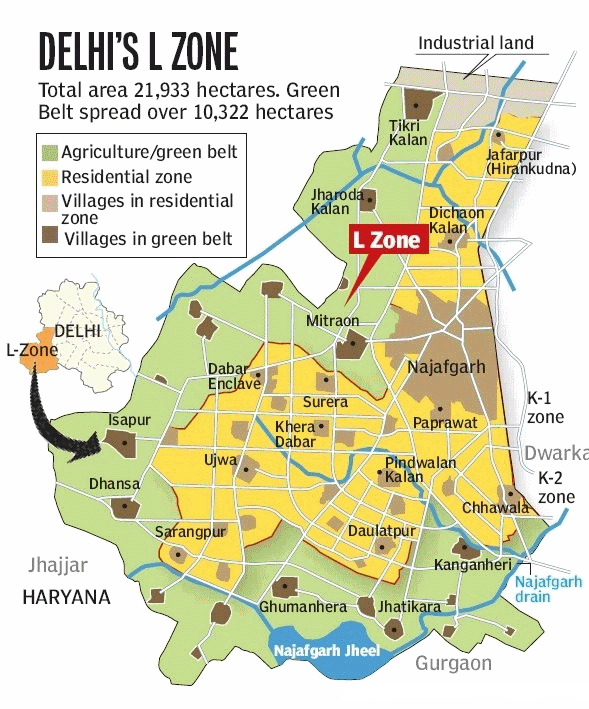
Zone L is the most popular zone among property buyers, housing societies and real estate developers. It has the highest land bank among all the zones in the MPD-2021. Many reputed builders of Delhi-NCR have not just stepped in but have already launched their new residential projects in L-Zone. L-Zone for being so strategically placed, is supposed to provide excellent returns on your investments. The property prices are way too low here as of now as compared to the adjacent already developed areas. But the land/property price in this zone is rising with each passing month.
L Zone, among all the zones, is probably the best in terms of location and connectivity.
L-Zone is close to IGI Airport. It is strategically located between Dwarka and Gurgaon; is close to Dwarka Sector 21 Metro Station and Dwarka expressway. The zone is in close proximity to New 18 Hole Golf Course, which is under construction and upcoming new diplomatic area. 80 M wide UER-II will connect L-zone with Airport, Dwarka and South-Delhi.
A substantial development of Residential, Commercial, Public and Semi-public segment will happen through public – private partnership. This is largest of all the zones to be a part of Delhi’s Land Pooling Policy. Hence it is expected to supply the largest share of property in the capital.
It is surrounded by NH-10/Rohtak Road and Railway Line on its North side; the NCT of Delhi’s boundary on its southern and western sides; and it is just a few kms away South Delhi and West Delhi.