


In this section, we will drill deeper into the concept to understand what must be the core Infrastructure to build up a Smart city.
Frost & Sullivan have identified eight key aspects that define a Smart City:
smart governance, smart energy, smart building, smart mobility, smart infrastructure, smart technology, smart healthcare and smart citizen
We have leveraged out of it while coming up with our own list.
Good governance:
This cannot be a one-time process. First and foremost there is a need to identify metrics to define it. Suggestions need to be sought from residents and experts alike. Consolidated list, then, should be filtered out to weed out parameters which could not be measured. Whole process should be put online for everyone’s review and then the process set must be evaluated for the actions taken. This could be used as a model to make new learnings and improvise the existing system in an incremental fashion.
Education:
We are not talking about just pre-schools, schools, colleges, university(ies), training centers etc, but, about defining ways to keep all citizens educated and informed on all policies and matters, which are directly or indirectly related to them. A number of health issues can be contained beforehand if residents are updated about them through some governmental or Non-profit organization(s).
Also, there is need to upgrade the existing educational system. We will also recommend a 360 degree review system, where not just the students will get rated for the performance but teachers / professors too will need to pass through the evaluation process. This will help them know their shortcomings and at the same time put pressure on them to perform better alike students.
Health:
It should not just be about Health care but Preventive Health care. Simple living, eating healthy, regular exercises, on-time vaccinations and other preventive services could reduce burden on overall Health care services. This would allow people to live a healthy, long and stress free life.
Technology is continuously improving and could be used to record, monitor and analyze the health details of individuals; maintain medical history; and guide them periodically to avoid expected health concerns based on their and their family history.
So, in the smart cities, IOT is not just going to digitize homes and elevate experience of online shopping, but also will make health care services smarter by taking away focus from cure to prevention.
Adequate water supply
Firstly, there will be a critical need for accurate forecasting of water consumption and use by the habitants. To us, a smart city should be self sustainable in terms of its water requirement. That would mean that it should be able to re-generate water, atleast most of it, from what it consumed. This will need to be coupled with water loss management to induce smart water concept for smart cities which has become increasingly important because of rising population and water scarcity.
24 x 7 Electricity Supply:
This will need to be looked upon from two sides.
One would be to increase the electricity generation capacity keeping in mind the expected population of the city when at peak and the average requirement of an average household which must be at par with the usage in developed countries using renewable energy solutions, such as, solar, wind etc.
At the same time, enough attention needs to be devoted in researching better technologies to reduce energy consumption by the commonly used devices. A good example to this is the transformation from the filament bulbs to CFL to LED.
Sanitation and cleanliness:
Everything in a smart city will need to be developed with sustainability at its core. Physical infrastructure would need to be developed for things like Solid waste management and proper disposal of garbage. What could be recycled should be recycled and rest should be treated in the most environmental-friendly manner possible.
Besides, enlightening citizens on the subject would be a major challenge. We would need to work with the people to make them aware about the importance of sanitation and cleanliness. Also, initial level of waste segregation will have to be done at the source itself and people will need to be guided on that too.
Transportation:
Transportation to humans is what internet is to computers. This will further break down to two major sub segments, i.e., Public and Private Transportation.
Isn’t this the right time to start thinking of reducing our dependence on transportation powered by fossil fuel? Yes!! It is time to start switching to e(lectronic)-Transportation. They are expensive as of now but with more manufacturers jumping in and a mass transition catalyzed by governmental mandate could make that affordable to the common people.
This should be complimented by an efficient and robust public transport system comprising of Metro Trains, electric trams, AC buses etc, coupled with pedestrian walkways and cycling lanes. A well knit transport network could ensure jam free traffic on roads and will have minimal participation in causing pollution.
Housing:
Real estate, let it be residential or commercial development, is both the cause and result of smart cities in some way. A smart city should have well planned, good quality and affordable housing solutions for all, at its core. Simultaneously, since there will always be a workforce in the lower and lower-middle group segment, provisions should be made for residential units and low budget markets for these people belonging to economically weaker section.
Healthy and Sustainable environment:
This could be achieved with effective use of renewable resources and minimizing dependence on fossil fuels. Green norms should be made a mandatory part of all planning, let it be for housing, transportation or any other entity.
Optimal digitization and Robust IT connectivity:
Wherever feasible, processes / services much be knit together with information technology. Internet speed in India has started to catch up with the rest of the world and new systems can be planned keeping in mind that it is going to get better in the coming years. We are expecting 5G in another 4 to 5 years time which would leave us with unending possibilities and applications. Cyber-security will assume an important role.
Safety and security:
Though, this in itself is a vast topic and is of utmost importance, we will stick to just a few concerns that should amicably be made part of this final chapter:
There were some more points which crossed our mind, but we will keep them for some other time.
Below are the links to the earlier parts of the series.
http://www.koncreteplanet.com/article/smart-cities-exploring-future-part-1/
http://www.koncreteplanet.com/article/smart-cities-exploring-future-part-2/
In our last post we explained what and why of the Land Pooling Policy. Today we will try to dig deeper into other salient features of the Delhi’s Land Pooling policy.
Under this Policy DDA will be undertaking urbanization of around 24,000 hectares of publicly owned land through land pooling to accommodate a population of around 50 Lakh in outer Delhi zones, namely, P-II, L, N etc.
DDA will be bringing all this land under one umbrella after converting it from its current Agricultural status to R-zone. This will comprise of High Density areas which should get to see high-rises and Low density residential areas also known as country homes.
In this section we will be discussing about the latter one.
‘Country homes’ is an exciting concept for anyone willing to have a lavish space at an affordable price within the capital. 23 villages have been earmarked under LDRA development. Also, 47 villages falling under green belt will be a part of this group.
DDA introduced new norms for owning farm houses in the capital via S.O. No – 1190 (E), on 10th May, 2013.
Key Points on LDRA / Country Homes
This will keep number of dwelling units in these areas in check and will make sure that the periphery of Delhi remains green & eco-friendly.
With all been said, there is just one more thing to add; Delhi is offering a limited opportunity to all to own a bungalow/farmhouse in the heart of the country.
In our next section/post, we will be discussing about the next feature of Land Pooling Policy, i.e., high density residential development.
Prospective buyers in and around Delhi have been struggling since a while with a very important question of whether they should invest in the NCR region or should wait for the Delhi’s Land Pooling policy to become operational. It has been all about the most preferred choice for home seekers in and around Delhi.
Since last few years, things have not been rosy for people who have somehow managed to pull in enough resources to buy some property in Delhi/NCR region. NCR region has been in a state of correction after witnessing India’s largest real-estate boom in the residential market. Builders are staring at a piled up inventory of unsold homes and that has led to dipping sales.
Economic slowdown has had an impact on all industries including real-estate sector. Then there had been other factors, such as delays which took a toll on the end user’s confidence. Per a survey done last year, construction for over 4 lakh flats was running over 2 years behind schedule. This has led Investors to go on their back foot causing a further setback and has acted as a roadblock in the pace of construction.
During the explosive early period when real-estate market in NCR was bullish, many builders passed reserves from one project into newer ones eyeing an exponential growth. This too led to the current financial crunch.
After witnessing the up’s and downs of the NCR real-estate market, Delhi is all set to join the bandwagon and should convincingly grab the spot for the most preferred/prominent real estate hub in North-India.
In the current offerings, sellers are refusing to lower their prices, and buyers are refusing to meet the asking prices for property. This has resulted in a standstill in the property transactions since the buyers are willing to wait further for the prices to become more affordable. Delhi’s Land Pooling Policy is for sure an answer to this deadlock which has all the ingredients for dwelling a true smart (sub) city right within the heart of the country and will offer smart homes to the smart buyers at affordable prices.
Though, the DDA’s ambitious land pooling policy for the capital has been in doldrums since its inception and has recently became victim of state-center apathy because of political-technical differences, will get to rise beyond expectations once it’s been through the current phase.
Stay in-tune for further updates on the Land Pooling policy which should soon step out of the paper on the real ground.
There are a number of options in the market for homebuyers interested in DDA’s Land Pooling Policy. This comprises of both Societies and builders. Also, there is no clarity on the legality of their existence and if they could sell the units before the commencement of anything concrete on the ground. So if one still feels keen in looking into the available options, we would like to offer a check list for the prospective buyers.
A number of like-minded individuals come together and decides to take a route leading them towards a common interest. With time more people would join the bandwagon ensuring the sustainability of the idea. As far as we understand, societies have always worked on a similar principal. DDA’s Land Pooling Policy is one such lucrative concept which has lured people from public / private companies alike into forming such housing /welfare societies to take advantage of the policy. DDA too has abstained from taking a clear stand on the legitimacy of such societies.
One must take into account certain precautions before investing into any proposed society/builder project in any of the zones under LPP.
Registration and Mutation of Land:
First comes the NOC after which comes registration of the land. It is then followed by mutation which could also be considered the most important step towards the procurement. One must ensure that the society holds the required papers for the land they claim to be theirs.
Do a background check:
Not all societies would be formed by genuine beings. Try not to get swept away with the market sentiment and do a thorough check for the authenticity of the managing committee.
Societies are supposed to work on a no-profit no-loss basis and no commercial activity should be carried out by them. They are supposed to get their accounts audited after the end of every financial year. Better level of communication is expected since most of the times they get formed with the participation of known ones.
Centre, State Tussle on LPP has become the reason for holding up of Delhi’s humongous potential of creating affordable homes. Group of experts tries to dissect the issue between State and Centre Government to get to the root cause and a probable solution to the stand-off.
Delhi’s L-Zone is located in South-West Delhi and is strategically positioned between Dwarka and Gurgaon. It is the most popular zone among property buyers of all the zones in Land Pooling Policy; and is expected to give an impetus to the slow and stagnant real estate market of the national capital.
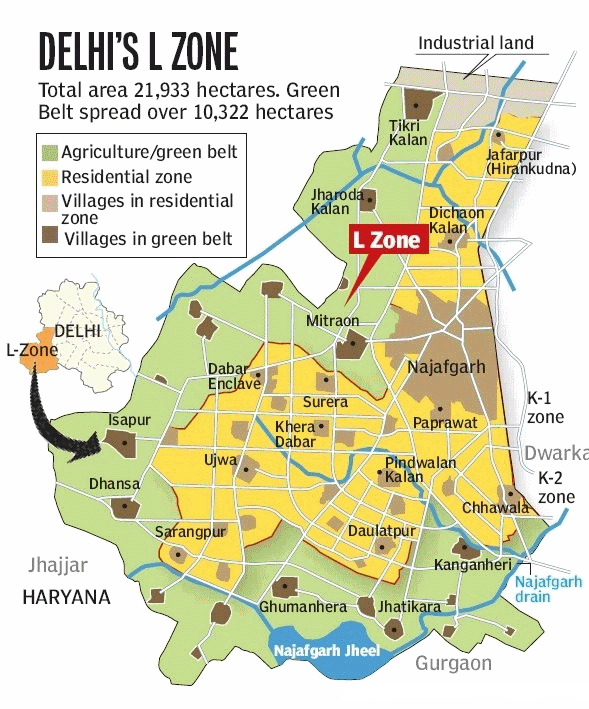
Zone L is the most popular zone among property buyers, housing societies and real estate developers. It has the highest land bank among all the zones in the MPD-2021. Many reputed builders of Delhi-NCR have not just stepped in but have already launched their new residential projects in L-Zone. L-Zone for being so strategically placed, is supposed to provide excellent returns on your investments. The property prices are way too low here as of now as compared to the adjacent already developed areas. But the land/property price in this zone is rising with each passing month.
L Zone, among all the zones, is probably the best in terms of location and connectivity.
L-Zone is close to IGI Airport. It is strategically located between Dwarka and Gurgaon; is close to Dwarka Sector 21 Metro Station and Dwarka expressway. The zone is in close proximity to New 18 Hole Golf Course, which is under construction and upcoming new diplomatic area. 80 M wide UER-II will connect L-zone with Airport, Dwarka and South-Delhi.
A substantial development of Residential, Commercial, Public and Semi-public segment will happen through public – private partnership. This is largest of all the zones to be a part of Delhi’s Land Pooling Policy. Hence it is expected to supply the largest share of property in the capital.
It is surrounded by NH-10/Rohtak Road and Railway Line on its North side; the NCT of Delhi’s boundary on its southern and western sides; and it is just a few kms away South Delhi and West Delhi.