


After approving the land pooling policy in September, last year, DDA is set to launch an online portal for operationalisation and implementation of the policy on 5th of Feb.
Also, a nodal officer has been appointed by DDA for it to coordinate with all service providing agencies, such as, DJB, PWD delhi, Transco etc.
Per officials, ‘integrated sector-based planning approach’ will be followed. A sector of 250 to 300 hectares of land will be eligible to be developed. A minimum of 70% contiguous land within a sector will need to be assembled to participate.
Keeping in line with the goal of ‘ease of doing business’, a single-window system is being created. This will be done to help with the implementation of the policy in DDA. All processes of receiving applications, verifications, grant of approvals and licences, etc., will be completed in a time-bound manner.
A two-stage grievance redressal mechanism has been set within DDA for transparent and people-friendly operationalization and implementation of the policy.
Under the policy, the FAR has been reduced to 200 as opposed to initially proposed FAR of 400.
Officials had maintained that reduction in FAR was done keeping in mind the availability of resources and services required for the development of a particular piece of land. The urban body will act as a “facilitator and planner” under the policy. The transfer of land to the DDA, which was proposed earlier, is no longer required.
DDA Vice-Chairman Tarun Kapoor had told The Hindu earlier this month, “The online portal for the land pooling policy is almost ready and trial runs are on currently.”
Also, DDA has initiated formation of an expert panel. Per reports, the panel formation should have completed by now. It will be comprised of town planners, planning and engineering experts etc. This panel will be responsible for drafting a detailed road-map for the policy. Firstly, zonal plans will be created which will be marked with details on land ear-marked for residential development, community halls, park, and parking and on sewerage and water pipe connectivity. The policy will then be carried forward per these details.
Courtesy: Navbharat Times, The Hindu, and other news sources.
Delhi’s LG Anil Baijal on 16th of May, 2017 (Friday) approved Land Pooling villages to be declared as developed areas. This will give a big push to Delhi’s planned development and affordable housing under DDA’s ambitious Land Pooling Policy (LPP).
The villages under Delhi’s Land Pooling policy are spread over nearly 77,000 acres, of which around 50 percent land will be made available to developer entities for real estate. The development of these 95 villages will result in over 25 lakh houses in the planned areas of the city. DDA will also be responsible for sewerage, water supply, electricity supply, bus terminals etc, and also return a portion of the plot to farmers.
To many, the news came through LG’s tweet, “Approved notification of 95 villages as development areas of DDA. Push for affordable housing, social and physical infrastructure needs of Delhi (sic).”
The villages to be developed under land pooling are from Delhi’s five zones, namely, Zone K1, L, N, P-II, and J.
Per DDA’s Land Pooling policy, individuals or a group of land owners owning land in villages in above mentioned five zones, marked for land pooling, can pool their land and hand it over to the Delhi Development Authority (DDA), which will develop basic public infrastructure like roads, before returning a substantial portion back to the owner.
The land owners offering between 5 to 50 acres of land for development will receive 48% (43%+3%+2%) of their land back, and those who would be pooling 50 acres or more of their land would get 60% (52%+5%+3%) of their pooled land back once the development is completed.
The leftover land will be used by DDA for purposes such as infrastructure development.
After initial setbacks/hurdles, the land pooling policy is set to change the character of the rural part of Delhi.
In a major development, LG has declared 89 villages in Delhi, marked for Land Pooling, as urban areas. The Urban Development Department of the Delhi government issued a notification in this regard in May, 2017, after Lt Governor Anil Baijal approved the Delhi Development Authority’s Land-Pooling Policy (LPP).
The policy was stuck for quite some time, leading to the mushrooming of unauthorized colonies in these rural areas. The proposal to allow land pooling is almost a decade old. Delhi Development Authority had notified the policy in June 2015. But it could not be implemented as the state government refused to address the file related to change of the land use of the village’s agricultural land.
The land use of the said agricultural land, falling under the scope of Delhi’s land pooling policy, was to be changed in two steps. On 16th May, 2017 (Tuesday), notification was done to change the character of the villages under land pooling policy from rural to urban areas. In the second step, this land will be declared as ‘development area’. After that, the land use will automatically become non-agriculture. Then, farmers will be asked to pool in their land under DDA’s policy by submitting the land documents, for land pooling to take place.
The LPP is aimed at getting individuals or a group of land-owners – living in urban villages on Delhi’s periphery – to pool their land and hand it over to the DDA. Delhi government will get land from DDA for developing facilities such as electrical sub-stations, schools etc.
The DDA will develop public infrastructure, such as, roads, on part of the pooled land and return a portion of the plot to the owner. The owners with upto 50 acres of land will get around 48% of their land share back and the ones with more than 50 acres will get around 60% of their pooled land back from the DDA. The returned portion of the land will have its value increased due to the development of infrastructure nearby.
The policy’s implementation is significant as this will pave way for the development of 25 lakh housing units and around 5 lakh EWS (Economically Weaker Sections) units. Providing relief to small farmers, self-penalty on DDA for delays, and flexibility to farmers to trade their land or tie up with developers for land-pooling are some of the important features of the policy.
After discussing the concept of Smart Cities from different perspectives we will move on to exploring the scope of smart cities in India and the proposed governmental plan for it, in this final chapter.
Smart Cities in India
Since the time our honorable Prime Minister, Mr Narendra Modi has raised pitch for the development of 100 smart cities in India, it has become talk of the town. In today’s topic we will go through what has already been done, and what is to be expected in the near future.
What will need to be seen is if it would be a complete makeover of the existing infrastructure and processes or if this would primarily comprise of retrofitting work to upgrade it a notch up on a few parameters.
It must be a collaboration of local and central government, businesses, non-profit organizations working in the field of environment, social upliftment and awareness etc, academia and the citizens willing to offer their insights into their idea of sustainability.
Either way, it would present with a great opportunity to step into the future. Employment opportunities would arise too and many will get opportunity to flex their creative sense.
Smart Cities in India
In 2015, 98 cities competed in the first round, and till date 27 cities have been selected under smart city mission which will get Rs 200 Cr for improving their infrastructure.
Strategies to be adopted:
The strategic components identified for area-based development in the Smart Cities Mission are:
Of the 98 cities and towns that will upgrade into smart cities, 24 are capital cities, another 24 are business and industrial centres, 18 are culture and tourism influenced areas, five are port cities and three are education and health care hubs.
(Source: http://smartcities.gov.in/)
Below are the links to the earlier parts of this series:
http://www.koncreteplanet.com/article/smart-cities-exploring-future-part-1/
http://www.koncreteplanet.com/article/smart-cities-exploring-future-part-2/
http://www.koncreteplanet.com/article/smart-cities-core-infrastructure-part-3/
After our last post when we were planning to get onto our next, we stumbled upon this topic and with it being relevant to our cause and since the honorable Prime Minister, Narendra Modi has already pitched for it by setting path for developing next 100 smart cities in the country, it became our pick of the week.
Now since the topic is too vast to be covered in one go, we will be splitting it into sections for easy maneuverability across the various fragments.
What is a Smart City?
We scrolled through numerous web pages, discussed with experts, but, found it difficult to extract a precise definition for a smart city. One thing that we could say for sure is that it is about an effort to take the quality of human life towards standards set at level of idealism.
Before understanding the “What”, we might need to get over with “Why”:
Some of the other terms that have been used for similar concepts are:
Digital city: This would comprise of locally focused, fully integrated, online network encompassing whole of city processes into a single seamless thread.
Flexicity: In a age where technology is growing exponentially, it would be a city having processes and infrastructure made flexible enough for the authorities to allow its upgradation to next version without breaking the existing system.
Intelligent City: A city planned after studying a range of data on air quality, whether conditions, humidity level, traffic, crime, socio-economic status etc to change systems and functionality of cities. Primary focus is on collecting terabytes of data using researchers / sensors etc and feeding the same to an optimal analyzer before letting the information pass through human scrutiny.
Knowledge-based city: A Knowledge-based city is the one that nurtures knowledge and provides an environment for it. William Lever, through his papers, have established a broad relationship between the quality of knowledge base and economy change.
MESH city: MESH stands for Mobile, Efficient, Subtle, and Heuristics. MESH Cities use adaptive, citizen-focused, self-forming networks to learn and inform new design solutions.
They all have their pros and focus on one or more aspects of modernization. As was mentioned earlier, Smart City is a concept that has no true definition and could be considered to be the one encompassing features from one or more of the above.
In the age of Information Technology, it could be safely said that no city could be given this tag until all the city processes / functions are fully digitized. Also, no city can become truly smart unless it is populated by well informed citizens. It should have a place and plan for people of all socio-economic status and with all sorts of cultural and religious beliefs.
After discussing out on what and why of Delhi’s Land Pooling Policy and Country Homes / LDRA, we will move on to the next and the most important section of the policy’s R-zone, i.e., High Density development.
The Policy will be bringing all this land under one umbrella after converting it from its current Agricultural status to R-zone. This will comprise of High Density areas which should get to see high-rises and Low density residential areas also known as country homes.
In this section we will be discussing about the former one.
The policy is based on a new concept of land aggregation against the traditional practice of land acquisition by the government(s) for undertaking large scale residential/commercial projects.
Under this, DDA will be undertaking urbanization of around 24,000 hectares of publicly owned land through land pooling to accommodate a population of around 50 Lakh in outer Delhi zones, namely, P-II, L, N etc.
Key Points: R-Zone – High Density – DDA’s Land pooling Policy
The policy aims at providing affordable housing to people and covers the huge gap between demand and supply
It is expected to deliver close to Seven hundred thousand of EWS flats for the poor and can help Delhi become slum free to a large extent.
Land Pooling Policy is expected to have an enormous impact on the residential as well as commercial real estate market in and around Delhi.
Though the Delhi govt has given a in-principle nod to the policy but once it puts its physical impression on it for approval, dream of millions of people to own a house in the capital’s upcoming smart cities will become a reality.
In our last post we explained what and why of the Land Pooling Policy. Today we will try to dig deeper into other salient features of the Delhi’s Land Pooling policy.
Under this Policy DDA will be undertaking urbanization of around 24,000 hectares of publicly owned land through land pooling to accommodate a population of around 50 Lakh in outer Delhi zones, namely, P-II, L, N etc.
DDA will be bringing all this land under one umbrella after converting it from its current Agricultural status to R-zone. This will comprise of High Density areas which should get to see high-rises and Low density residential areas also known as country homes.
In this section we will be discussing about the latter one.
‘Country homes’ is an exciting concept for anyone willing to have a lavish space at an affordable price within the capital. 23 villages have been earmarked under LDRA development. Also, 47 villages falling under green belt will be a part of this group.
DDA introduced new norms for owning farm houses in the capital via S.O. No – 1190 (E), on 10th May, 2013.
Key Points on LDRA / Country Homes
This will keep number of dwelling units in these areas in check and will make sure that the periphery of Delhi remains green & eco-friendly.
With all been said, there is just one more thing to add; Delhi is offering a limited opportunity to all to own a bungalow/farmhouse in the heart of the country.
In our next section/post, we will be discussing about the next feature of Land Pooling Policy, i.e., high density residential development.
The land-pooling policy was notified on 5 Sep, 2013; and regulations for its operationalization were approved by UD ministry in 2015. All we are waiting for is the declaration of 95 villages as urban.
Why Land Pooling?
Till now, Delhi had been at the mercy of DDA for the development of new housing units; or the city was being burdened by unauthorized construction by converting agricultural land into unauthorized colonies. DDA had never been capable of meeting the housing requirement of the capital and neither were they able to meet the construction standards been set by the builders. Besides, land acquisition is no longer a preferred mode for accumulating large chunks of land for bringing up of planned township. There have been several occasions where such projects had to face farmer agitations at some stage.
Yes, Land-Pooling is the answer we had been waiting for to meet the growing housing and infrastructural needs, and to turn the capital into the city of the future.
What is Land Pooling?
DDA’s land pooling policy envisages public-private partnership in land assembly and development in Delhi. Delhi’s Land-Pooling is a concept where small chunks of land, owned by group of owners, will be assembled for the development of infrastructure and smart sub-cities, as per the provisions of the Delhi Development Act 1957. After the development of land, DDA will redistribute the land after deducting some portion as compensation towards infrastructure costs.
Land owners, let they be farmers, societies, or builder groups, will be considered as Developer Entity (DE) by DDA. DE having 50 acres (20 Ha) or more land will get 60% land back while others having over 5 acres but less than 50 acres of land will get around 48% of land back from DDA. The remaining land would be used by DDA for infrastructure development per MPD 2021.
DDA in association with the govt will act as a facilitator with minimum intervention and will catalyze speedy, integrated planned development. Govt/DDA will have regulations in place for building standards , delivery time etc, but, will otherwise give a free hand to the Developer Entities on pricing etc.
Through this policy DDA will be able to develop the urban extension area, measuring roughly 24 thousand hectares. These areas will be self contained with all facilities and infrastructure.
Prospective buyers in and around Delhi have been struggling since a while with a very important question of whether they should invest in the NCR region or should wait for the Delhi’s Land Pooling policy to become operational. It has been all about the most preferred choice for home seekers in and around Delhi.
Since last few years, things have not been rosy for people who have somehow managed to pull in enough resources to buy some property in Delhi/NCR region. NCR region has been in a state of correction after witnessing India’s largest real-estate boom in the residential market. Builders are staring at a piled up inventory of unsold homes and that has led to dipping sales.
Economic slowdown has had an impact on all industries including real-estate sector. Then there had been other factors, such as delays which took a toll on the end user’s confidence. Per a survey done last year, construction for over 4 lakh flats was running over 2 years behind schedule. This has led Investors to go on their back foot causing a further setback and has acted as a roadblock in the pace of construction.
During the explosive early period when real-estate market in NCR was bullish, many builders passed reserves from one project into newer ones eyeing an exponential growth. This too led to the current financial crunch.
After witnessing the up’s and downs of the NCR real-estate market, Delhi is all set to join the bandwagon and should convincingly grab the spot for the most preferred/prominent real estate hub in North-India.
In the current offerings, sellers are refusing to lower their prices, and buyers are refusing to meet the asking prices for property. This has resulted in a standstill in the property transactions since the buyers are willing to wait further for the prices to become more affordable. Delhi’s Land Pooling Policy is for sure an answer to this deadlock which has all the ingredients for dwelling a true smart (sub) city right within the heart of the country and will offer smart homes to the smart buyers at affordable prices.
Though, the DDA’s ambitious land pooling policy for the capital has been in doldrums since its inception and has recently became victim of state-center apathy because of political-technical differences, will get to rise beyond expectations once it’s been through the current phase.
Stay in-tune for further updates on the Land Pooling policy which should soon step out of the paper on the real ground.
Delhi’s L-Zone is located in South-West Delhi and is strategically positioned between Dwarka and Gurgaon. It is the most popular zone among property buyers of all the zones in Land Pooling Policy; and is expected to give an impetus to the slow and stagnant real estate market of the national capital.
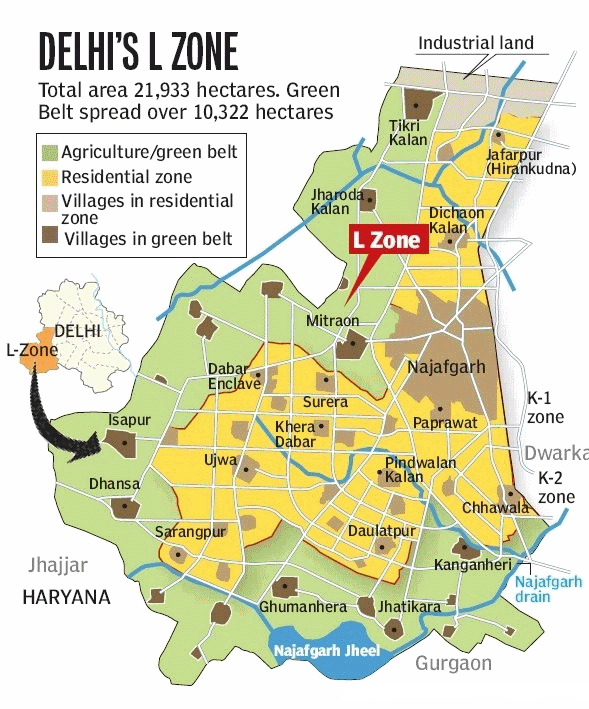
Zone L is the most popular zone among property buyers, housing societies and real estate developers. It has the highest land bank among all the zones in the MPD-2021. Many reputed builders of Delhi-NCR have not just stepped in but have already launched their new residential projects in L-Zone. L-Zone for being so strategically placed, is supposed to provide excellent returns on your investments. The property prices are way too low here as of now as compared to the adjacent already developed areas. But the land/property price in this zone is rising with each passing month.
L Zone, among all the zones, is probably the best in terms of location and connectivity.
L-Zone is close to IGI Airport. It is strategically located between Dwarka and Gurgaon; is close to Dwarka Sector 21 Metro Station and Dwarka expressway. The zone is in close proximity to New 18 Hole Golf Course, which is under construction and upcoming new diplomatic area. 80 M wide UER-II will connect L-zone with Airport, Dwarka and South-Delhi.
A substantial development of Residential, Commercial, Public and Semi-public segment will happen through public – private partnership. This is largest of all the zones to be a part of Delhi’s Land Pooling Policy. Hence it is expected to supply the largest share of property in the capital.
It is surrounded by NH-10/Rohtak Road and Railway Line on its North side; the NCT of Delhi’s boundary on its southern and western sides; and it is just a few kms away South Delhi and West Delhi.